Gambling addiction: warning signs and help in Mexico
 Play now ›
In this article
Gambling addiction does not start on the day of the big loss. It starts earlier, when betting stops being something you choose and becomes something that asks for you. In this guide we explain what gambling addiction, known in Mexico as ludopatía, is according to the World Health Organization (WHO) and IMSS, Mexico’s social security health service. We cover the signs worth taking seriously, the first steps to stop betting and the free services you can call in Mexico. This is general information, not a diagnosis or medical advice. If something here describes you, a health professional can look at it with you.
What gambling addiction is, and when it stops being a pastime
The WHO calls it gambling disorder and lists it in its International Classification of Diseases (ICD-11). A diagnosis looks at three things. First, the person loses control over when, how much and how long they gamble. Second, gambling gains priority until it overrides other interests and daily life. Third, they keep gambling even after it has negative consequences.
IMSS describes it as a mental health problem, also known as pathological gambling, in which a person struggles to control the urge to gamble and bet. It is not a lack of character or a habit you can scold away. It is a condition that can be treated, and the earlier it is spotted, the easier it is to stop.
The harm does not stay with the person who gambles either. The WHO estimates that about 1.2% of the world’s adults have a gambling disorder, and it warns that gambling harm reaches families and people close to them through financial stress, broken relationships and other mental health problems.
Signs of gambling addiction worth taking seriously
Our responsible gambling guide has a short list you can check in a minute. Here we go one step further and sort the signs by the three traits the WHO uses, plus the symptoms IMSS points out.
| What changes | How it shows up day to day |
|---|---|
| Control | You set a cap and go past it, bet more to feel the same, come back “to win back what you lost” |
| Priority | You think about the next bet at work or at dinner, skip plans and sleep to play |
| Consequences | Debts, loans, arguments at home, lying about how much you play, and you still carry on |
| Withdrawal | Anxiety, insomnia or irritability when you try to stop or cut back |
IMSS also mentions a sign that tends to come late and weighs heavily, which is getting into debt and looking for money through unusual means, sometimes even outside the law. If you are already there, do not wait to “sort out the numbers” before asking for help. Help is exactly what sorts them out.
A practical clue on your phone. If you open the casino without deciding to, the way you check messages, or if your bets grow in the early hours, pay attention. Chasing losses does not work as a plan either. Results are random and a game’s RTP is a very long-term average, not a debt the game owes you.
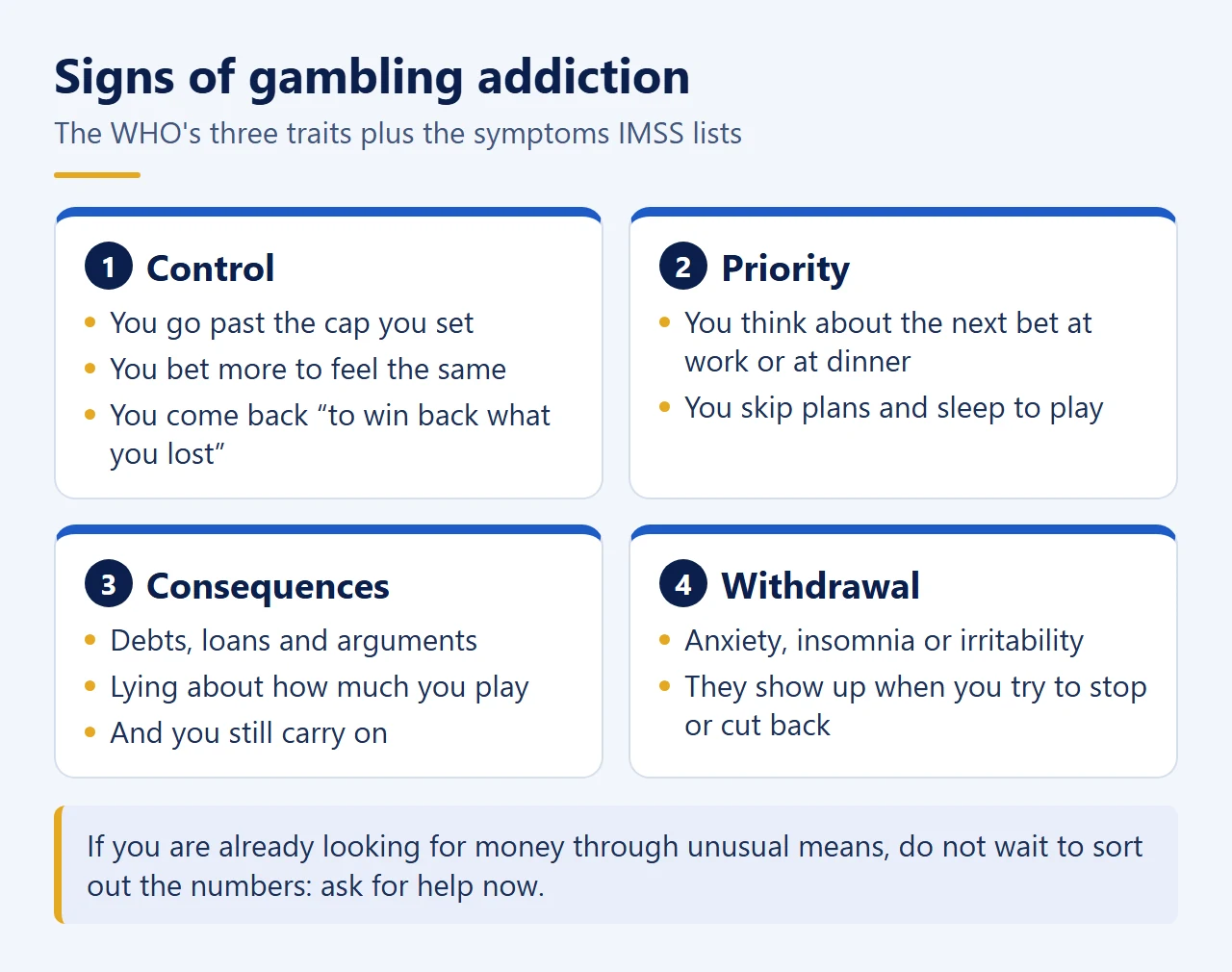
Our illustration fits the table above into four cards you can scan at a glance; the traits come from the WHO fact sheet and the symptoms from IMSS.

Why it hits some people harder
According to IMSS, gambling addiction has no single cause. Psychological factors play a part, such as anxiety, depression, bipolar disorder or ADHD. So do biological ones, such as differences in the dopamine system or a family history of substance use. And social ones too, such as easy access from a phone, a tablet or a card, gambling being seen as normal, money problems and aggressive advertising.
Knowing this is not meant to scare you, but to stop you from blaming yourself too much. If you live with anxiety or depression and notice that betting has become your way out, that is one more reason to talk to a professional, because treating one helps with the other.
How to stop betting: first steps
Stopping on willpower alone is the hardest way. It works better to take opportunities away from the urge while help is on its way.
- Cut off access. If you play at JuegaLotto, self-exclusion for 7, 30 or 90 days freezes your account and you cannot lift it yourself before the time is up. If you are unsure about the length, pick the longer one.
- Put the money out of reach. Let someone you trust help you with your cards or bank account for a while, and do not take loans to cover losses.
- Say it out loud. Telling someone close to you removes the secrecy, which is part of what keeps the problem going.
- Call Línea de la Vida or go to your clinic. The options are in the table below.
- Fill the time. IMSS recommends recreational activities without betting. Have a plan for the hours you used to spend playing.
It helps to know what the account has and what it does not. JuegaLotto currently has no deposit, bet or time limits, so self-exclusion is the tool for stopping. In PG Soft games, autoplay asks for a loss limit, but that is the provider’s control inside that game and it does not replace a break.
Where to get help for gambling addiction in Mexico
| Service | What it offers | How to reach it |
|---|---|---|
| Línea de la Vida (CONASAMA, Ministry of Health) | Free, confidential phone support, guidance, crisis intervention and referral to specialised centres | 800 911 2000, 24 hours, 365 days |
| IMSS family medicine clinic (UMF) | Medical assessment; if needed, referral to Psychiatry and Psychology, plus Social Work support | At your UMF, if you are an IMSS member |
| IMSS mental health phone line | Listening, crisis support and referral | 800 2222 668, option 4, 7:00 to 23:00, with your social security number |
| Grupo Punto de Partida | A help resource JuegaLotto lists in its site footer | From the footer of juegalotto.com.mx |
Línea de la Vida does not expect you to know exactly what is happening to you. You can call to describe what you notice and get guidance. If at any point you feel in danger or think about hurting yourself, call 911 or Línea de la Vida right away.
If the person you are worried about is someone else, IMSS stresses that family support is crucial. The responsible gambling guide linked above has tips for talking to someone close without judging them.
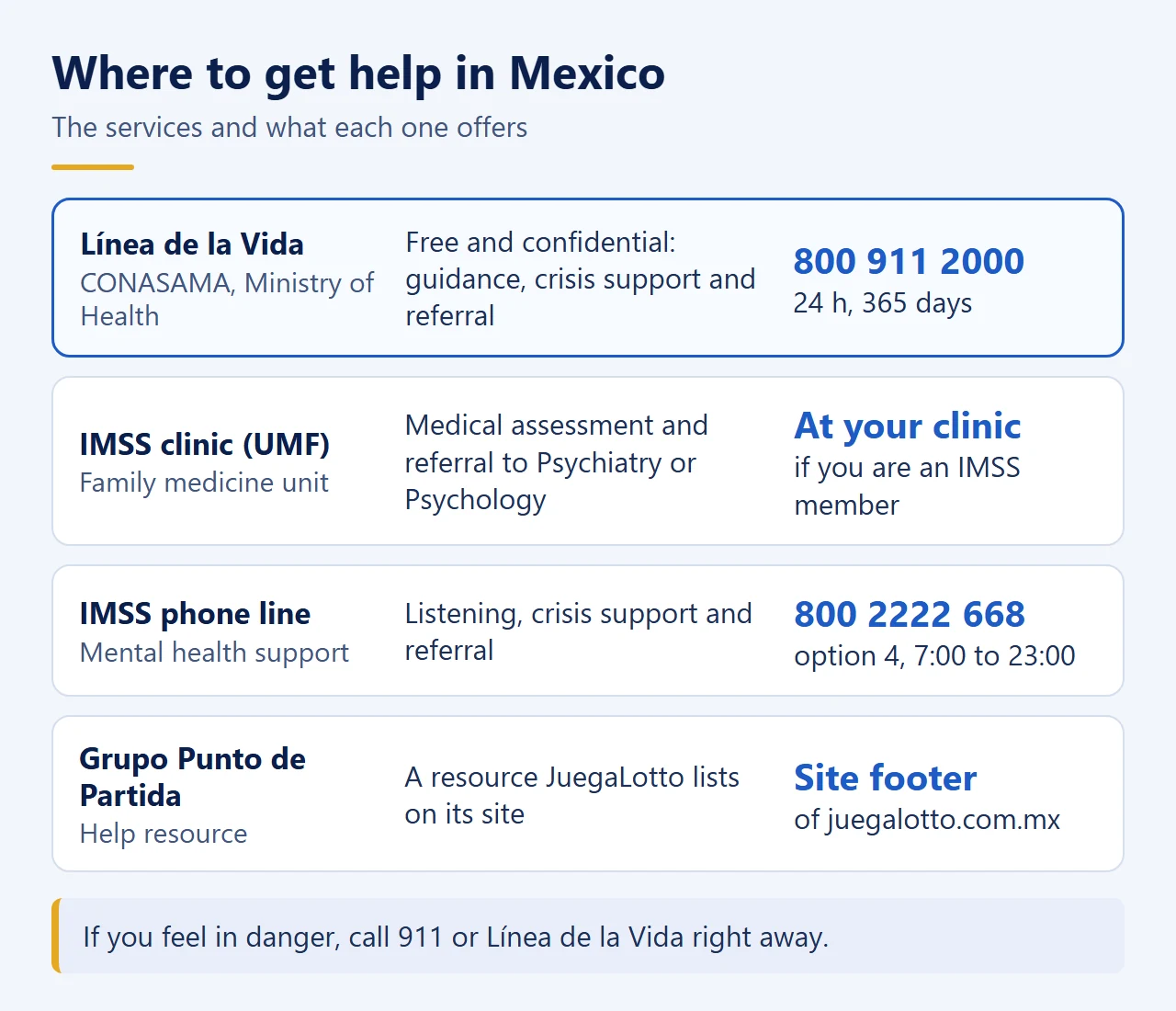
We put this summary together so the numbers are close at hand, with Línea de la Vida highlighted because it answers around the clock, as listed in the IMSS self-help guide.
Play responsibly
JuegaLotto is only for adults 18 and over in Mexico. Betting is entertainment that costs money, never a way to earn income or get out of debt. If gambling has stopped being fun, a break and a phone call do more than the next bet.
Sources
We checked these pages on November 16, 2026.
- WHO, fact sheet “Gambling” (December 2, 2024), with the ICD-11 criteria and the 1.2% estimate — https://www.who.int/news-room/fact-sheets/detail/gambling
- IMSS, press release 270/2025 “Alerta IMSS síntomas y riesgos de la ludopatía, adicción al juego y las apuestas” — https://www.imss.gob.mx/node/110606
- IMSS, “Guía de autoayuda para conducta suicida”, helplines section (Línea de la Vida and the IMSS phone line) — https://www.imss.gob.mx/sites/all/statics/salud/mental/GuiaAutoayuda.pdf
- PAHO, “Celebran 25 años de la Línea de la Vida” (June 18, 2024) — https://www.paho.org/es/noticias/18-6-2024-celebran-25-anos-linea-vida





Frequently asked questions
Is gambling addiction a mental illness?
Yes. The WHO lists gambling disorder in its classification of diseases (ICD-11), and Mexico's IMSS describes it as a mental health problem in which a person struggles to control the urge to gamble and bet.
Where can I get free help for gambling addiction in Mexico?
Línea de la Vida, at 800 911 2000. It is free and confidential, run by the National Commission for Mental Health and Addictions (CONASAMA) and open 24 hours a day, 365 days a year. If you have IMSS coverage, you can also start at your family medicine clinic.
How do I stop betting when I can't control it anymore?
Cut off access first (at JuegaLotto, with 7, 30 or 90 days of self-exclusion), put the money you gamble with out of reach, tell someone you trust and look for professional support. Willpower alone is usually the hardest route.
What are the symptoms of gambling addiction?
The WHO defines it by three traits, which are losing control over gambling, giving it more and more priority over other things and carrying on despite the consequences. IMSS adds debts, looking for money through unusual means, and anxiety, insomnia or irritability when trying to stop.