
RTP and volatility: what they mean at a casino
 Play now ›
In this article
RTP and volatility are the two numbers quoted most often about a casino game, and the two most often misread. RTP says how much a game returns over the very long run. Volatility says how that return is spread out. Neither predicts your next session, but together they explain why two games with the same percentage feel so different. Here we explain what they mean, with sums in pesos, and how to use them without expecting what they cannot give.
What RTP means at a casino
RTP stands for return to player. It is the theoretical percentage of everything wagered that a game gives back to players over an enormous number of plays. The gap up to 100% is the house edge.
Take Fortune Ox, which has an RTP of 96.75% at JuegaLotto. For every 1,000 MXN wagered, the maths returns 967.50 MXN on average and keeps 32.50 MXN. Note that this is about money wagered and not money deposited. If you spin the same 100 pesos several times, each round counts again, so your total wagered soon passes what you put in.
What RTP does not tell you
RTP does not mean you get 96.75 pesos back if you play 100. In a short session you can end far above or far below that, because the average only gets close to real results after millions of plays.
It is not a scoreboard that evens out, either. A game does not “owe” a win because it has not paid for a while, since each result comes from a random number generator (RNG) and is independent of the last. That is why there are no hours that pay more and no spins that signal a win.
And a higher RTP does not turn a game into a way to make money. It only lowers what you can expect to lose over the long run. On slots that number does not depend on you, but in blackjack your decisions count, and blackjack basic strategy is the decision chart that keeps that expected loss at its minimum.

What volatility means
Volatility, also called variance, describes how wins arrive. Two games can share an RTP and behave very differently.
| Volatility | How wins tend to arrive | How playing feels |
|---|---|---|
| Low | More often and smaller | Your balance moves up and down gradually |
| Medium | Somewhere in between | Short runs in both directions |
| High | Rarer, with bigger wins possible | Many spins with no big win, and sharp jumps |
High volatility needs the biggest budget to reach its features, and it is easy to mistake a bad run for something that “has to” turn. On a short budget, a high-volatility game can finish your money before a special feature appears. That does not make it better or worse, just rougher.
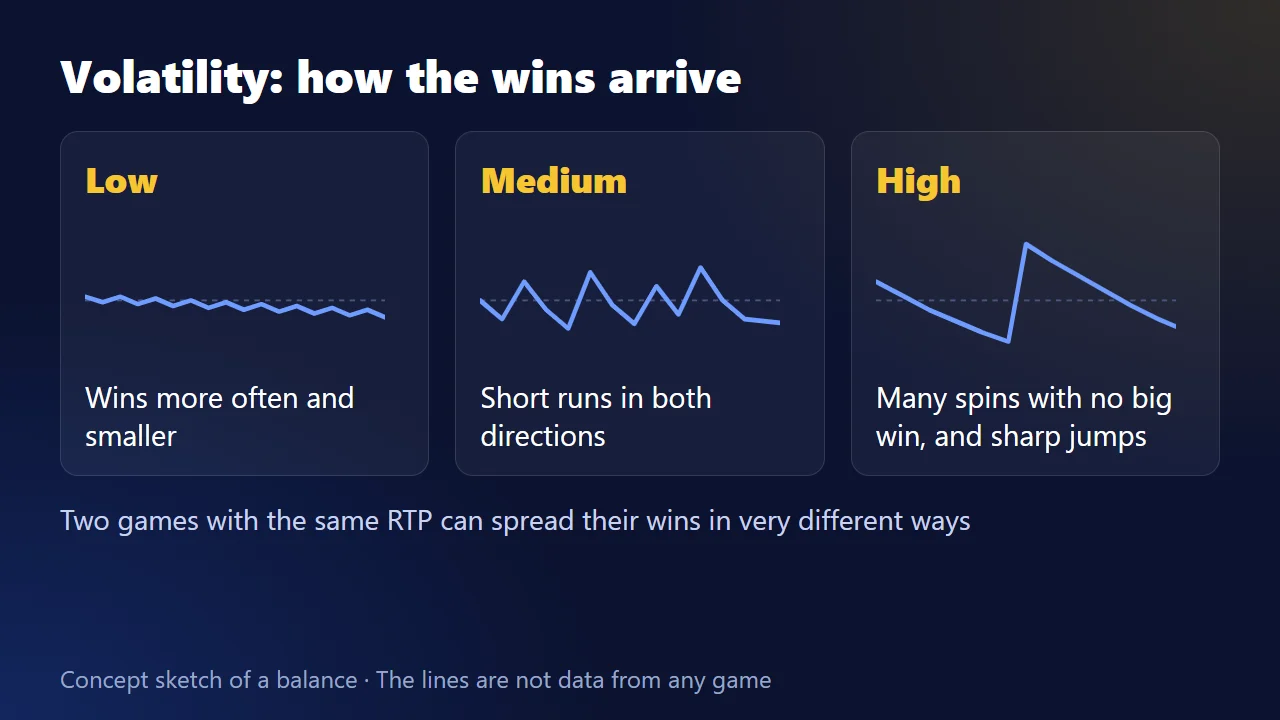
The lines are a concept sketch rather than data from a game, but they help picture how a balance moves at each volatility level.
How RTP connects to wagering requirements
This is where RTP becomes really useful. A wagering requirement makes you play a set amount before withdrawing, and every peso wagered pays the house edge on average.
Here is an example with JuegaLotto’s first-deposit bonus, which has an 8× bonus requirement. A 30 MXN bonus asks you to wager 240 MXN. In a game with a 96.75% RTP, the theoretical cost of that wagering is 7.80 MXN, and it moves up or down with the game’s RTP.
That is an average and not a promise, because volatility can leave you at zero before you finish or above the calculation. The current conditions are always shown on the platform.
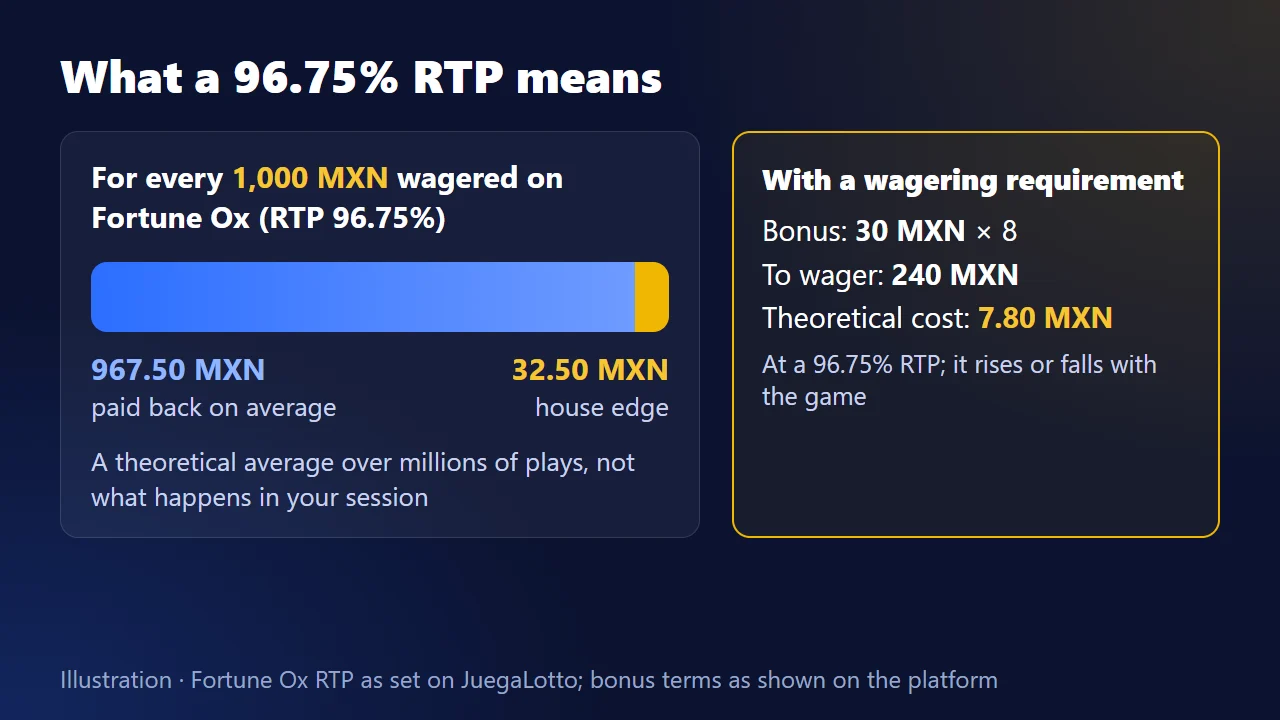
The bar splits what the game returns on average from the house edge, and the gold card applies the same sum to the bonus in the example.
How to use these numbers when choosing a game
Look for RTP and volatility in the paytable or game rules. If a provider offers several versions with different RTPs, the value that counts is the one configured on the platform you play on, which is why our game pages give JuegaLotto’s figure. To see tables and slots side by side, our list of casino games with the best RTP ranks them by house edge. Our slots guide also covers reels, paylines and special features.
Then decide based on your budget. Ask how much you can lose in the session and pick a volatility that lets that amount last. If the provider does not publish volatility, treat it as unknown rather than guessing from how your last few spins went.
Play responsibly
Knowing RTP and volatility tells you what to expect; it does not beat the house. No game at JuegaLotto assures winnings, and it is for adults 18+ only. If you notice you are raising bets to win back losses, stop and read our responsible gambling guide or call Línea de la Vida on 800 911 2000.








Frequently asked questions
What is RTP at a casino?
It is the theoretical percentage of money wagered that a game returns to players over the very long run. An RTP of 96% means an average return of 96 pesos for every 100 wagered, across millions of plays.
Does a high RTP mean I will win?
No. RTP is an average across a huge number of plays and says nothing about your session. Even with a high RTP, the expected long-run result is losing part of what you wager.
What is volatility in slots?
It describes how wins are spread out. With low volatility they tend to be more frequent and small; with high volatility they are rarer but can be bigger.
Does RTP change between casinos?
It can. Some providers offer versions of the same game with different RTPs, and the value that applies is the one configured on each platform.